COMING IN NOVEMBER 2026
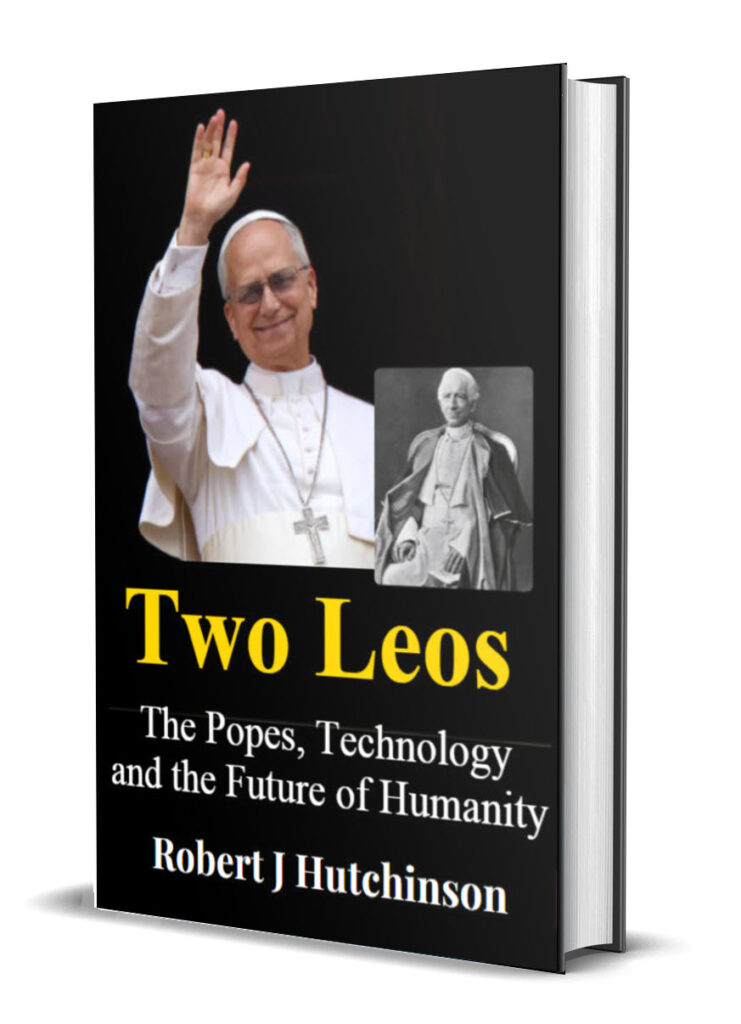
Two Leos: The Popes, Technology, and the Battle for Humanity’s Future
By Robert J. Hutchinson
When Robert Francis Prevost stepped onto the loggia of St. Peter’s Basilica on May 8, 2025, and announced that he would be called Leo XIV, Catholics around the world asked the same question: why Leo?
The answer reaches back more than a century, to a remarkable Italian nobleman named Vincenzo Pecci who became Pope Leo XIII and changed the Church’s relationship to the modern world forever. In Two Leos, veteran Catholic author Robert J. Hutchinson — author of When in Rome, Searching for Jesus and The Dawn of Christianity — offers the first dual biography of these two extraordinary popes, tracing their parallel lives across two centuries and two civilizational crises: the Industrial Revolution that shattered the old social order, and the artificial intelligence revolution that is reshaping ours. Along the way, Hutchinson tells the story of Catholic social teaching itself — what it is, where it came from, and why it may be exactly what the world needs now.
Two Popes, Two Revolutions
For two thousand years, the Roman popes have stood as a prophetic voice against the delusions and barbarisms of empires, proclaiming the simple truth that every human being is precious in the eyes of God and cannot be used as a pawn in whatever schemes kings, CEOs, or government bureaucrats may have in mind.
Pope Leo XIII (1810–1903) grew up in a world of peasant agriculture and parish-centered communities—a pre-industrial economy whose logic shaped everything he later wrote. When the Industrial Revolution destroyed Europe’s agrarian economies and reduced millions to slavery in urban factories, Leo responded with Rerum Novarum (1891), the landmark encyclical that rejected both laissez-faire capitalism and revolutionary socialism, insisting that workers have natural rights to association, living wages, and property—and that the state has obligations to protect those rights.
Pope Leo XIV grew up in suburban Chicago as the sexual revolution reshaped American societies and dissolved stable immigrant Catholic communities. A missionary for 13 years during Peru’s bloody civil war against Marxist revolution, he witnessed the effects of a globalized economy in the faces of poor children. His choice of name signaled a conscious resumption of Leo XIII’s moral crusade —this time to confront the globalized economy, artificial intelligence, and the rise of new reproductive technologies that make Brave New World look tame.
What This Book Does
Two Leos is a work of political philosophy in the form of a dual papal biography. It traces how two popes, separated by more than a century, confronted the same fundamental crisis: What happens when technological revolution makes human beings expendable? Leo XIII watched industrial capitalism reduce workers to interchangeable units in a factory system. Leo XIV is watching artificial intelligence do the same to knowledge workers, genetic engineering redefine what it means to be human, and a globalized economy subordinate entire nations to corporate profit margins. The book doesn’t prescribe a single political program. Rather, it asks whether any system that treats persons as means rather than ends can be made just, and what it would take to build one that does.
What You’ll Find Inside
- How Leo XIII used thirty—two years of “exile” in Perugia to develop the intellectual framework for modern Catholic social teaching
- Robert Prevost’s formation in Peru during the Shining Path insurgency, and what it taught him about just war, violence, and institutional competence
- The Church’s long argument with liberalism—from the Enlightenment through Vatican II to today’s post—liberal moment
- Why Rerum Novarum’s rejection of both capitalism and socialism remains the most intellectually serious alternative to libertarian individualism and collectivism
- Leo XIV’s early statements on AI, migration, genetic engineering, and the “culture of death”—and whether papal humanism has the resources to be right about the second Industrial Revolution
About the Author
Robert J. Hutchinson has spent thirty years writing about the Catholic Church and the origins of Christianity. He is the author of When in Rome: A Journal of Life in Vatican City (1998), Searching for Jesus: New Discoveries in the Quest for Jesus of Nazareth (2015), and The Dawn of Christianity (2017). Hutchinson studied philosophy as an undergraduate, moved to Israel to learn Hebrew, and earned an MA in theology. He is currently pursuing doctoral studies in philosophy at a European university.
? Download the Introduction Chapter Free
Get early access to the full introduction and chapter-by-chapter outline—see what the book covers and why it matters now.
? Download Introduction PDF
? Book the author for podcast or media outlet
